Showing posts with label Articles. Show all posts

Thursday, December 22, 2022

Recognition date under IFRS 17 Insurance Contracts


Welcome to IFRS is easy!

IFRS 17 Insurance contracts - Part 4

I raised a poll on IFRS is easy's LinkedIn page and here is the result.

Note that the results here are not necessarily correct. Please continue reading for the correct answer.

Say today is 18 December and you approach an airline (whose accounting year end is 31 December) to book a flight that you intend to take on 2 January. The flight takes approximately 24 hours, so you get to your destination on 3 January. What date do you think the airline will recognize revenue?

The above explains why recognition date is an important concept in all accounting standards.

Under IFRS 9, on the day you become a party to the contractual provisions of a financial instrument, you are required to start recognizing the instrument in your books. So what does IFRS 17 say about recognition?

Now let's go back to our poll.

IFRS 17 extends its requirements because of the peculiarity that comes with transacting with policyholders.

The standard requires companies to recognise a group of insurance contracts issued from the EARLIEST of the following:

  • the beginning of the coverage period of the group of contracts;
  • the date when the first payment from a policyholder in the group becomes due; and
  • for a group of onerous contracts, when the group becomes onerous.

The coverage period starting from 1 Jan is the earliest date in the poll options.

Yes! You made it to the end.

I will be happy to receive any questions you may have about the topic discussed in this blog post.

Share in the comment section about the misconceptions you once had about IFRS 17.

Don’t forget to subscribe to our YouTube channel to get all new IFRS analyses. Also, click on the email subscription button on this page so as not to miss any of our blog updates. 


Written by:

Adedamola Otun

For: IFRS IS EASY

Measurement components of IFRS 17 Insurance contracts


Welcome to IFRS is easy!

IFRS 17 Insurance contracts - Part 3

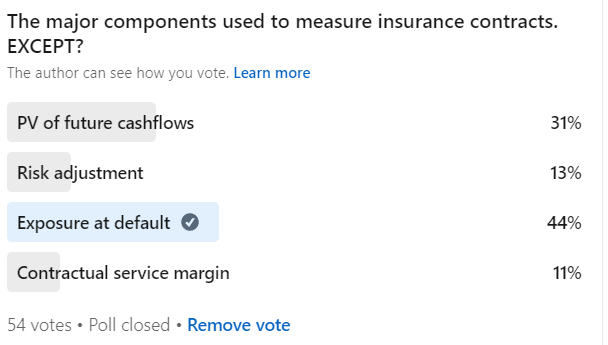
I raised a poll on IFRS is easy's LinkedIn page and here is the result.

Note that the results here are not necessarily correct. Please continue reading for the correct answer.

If you are familair with IFRS 9, you most likely still remember the components that we consider in testing for impairment on financial assets.

To jug your memory, they are Exposure at Default (EAD), Loss Given Default (LGD) and Probability of Default (PD). I will discuss these and the required computations in later posts after completing the IFRS 17 introduction series.

There are 3 major components in measuring insurance contracts:

1. Present value of future cash flows

2. Risk adjustment

3. Contractual service margin

Now let's talk briefly through them.

Present value of future cash flows

When an insurance company receives premiums from the policyholder, many times, the premiums are not one-off. They are often annual payments made by the policyholder over the insurance coverage period. And as you already know, the time value of money always kicks in when cash flows are over a period of time. This is the reason why we are talking about present value.

Simply, the present value of future cash flows is the financial risk of the insurance contract. It represents the discounted inflows (premiums) and outflows (expected claims to be paid to the policyholder, acquisition cost incurred in winning over the policyholder and other direct expenses).

Risk adjustment

This is the compensation to the insurer for bearing the non-financial risk of insuring the policyholder.

Contractual service margin

This is the unearned profit of the insurer that is amortised over the insurance coverage period.

There's a fourth guy in the wheel called the "Fulfillment cash flows". This is simply the addition of the present value of future cash flows and the risk adjustment.

Yes! You made it to the end.

I will be happy to receive any questions you may have about the topic discussed in this blog post.

Share in the comment section about the misconceptions you once had about IFRS 17.

Don’t forget to subscribe to our YouTube channel to get all new IFRS analyses. Also, click on the email subscription button on this page so as not to miss any of our blog updates. 


Written by:

Adedamola Otun

For: IFRS IS EASY

How to measure insurance contracts under IFRS 17


Welcome to IFRS is easy!

IFRS 17 Insurance contracts - Part 2

I raised a poll on IFRS is easy's LinkedIn page and here is the result.

Note that the results here are not necessarily correct. Please continue reading for the correct answer.

Almost all accounting standards describe the approach to use in computing the numbers. For example, IAS 2 will tell you to use First-In-First-Out or weighted average method to compute the value of your inventories.

Likewise, IFRS 9 will tell you to use general or simplified method for the value of your impairment allowance on financial assets.

If you consider the complexity in IFRS 9 and IFRS 17, you may see why IFRS 17 did not hesitate to create a simplified method alongside the general method.

There are 3 measurement models for accounting for insurance contracts under IFRS 17.

  • General model (Known as the Building Block Approach)
  • Simplified model (Known as the Premium Allocation Approach)
  • Variable Fee Approach

But before we discuss each of them, there's an important term to note. It's called Participation Feature.

If you are new to insurance, you may be surprised as I am, that there are some contracts that gives the policyholder the benefit of sharing in the gains of the insurer. What this means is that when the insurer receives premiums from the policyholder and invests those premiums, the gains on the investment is shared between the insurer and the policyholder.

This is referred to as a participation feature and it can be direct or indirect.

What is a direct participation feature?

A direct participation feature (DPF) means that the kind of gain that the policyholder gets from the premiums invested meets the 3 criteria below. If they don't, then they are indirect.

  1. The underlying items (the investments) that the policyholder wants to participate in must be clearly identified
  2. The amount that the insurer wants to pay the policyholder must be a substantial share of the value of the investments
  3. Any changes in the amounts the insurer wants to pay the policyholder must vary with the change in the investments

So now let's briefly talk about when you should use the 3 measurement approaches.

If there is a DPF in an insurance contract, the variable fee approach is used. This is because the insurer will deduct a variable fee for the insurance service it has rendered to the policyholder through the investments.

This implies that the general model and the simplified model are used for other insurance contracts especially when there is no participation feature.

Also, the general model is used for the indirect participation feature.

Simplified model is a simplification of the general model and is often used for insurance contracts that are one year or less, or whose result is similar to the general model.

Yes! You made it to the end.

I will be happy to receive any questions you may have about the topic discussed in this blog post.

Don’t forget to subscribe to our YouTube channel to get all new IFRS analyses. Also, click on the email subscription button on this page so as not to miss any of our blog updates. 


Written by:

Adedamola Otun

For: IFRS IS EASY

Effective date and Application of IFRS 17 Insurance contracts


Welcome to IFRS is easy!

IFRS 17 Insurance Contracts - Part 1

When I started my career in Accounting Advisory, I had a misconception that I was meant to know everything in each Accounting Standard because most of my client engagements often requires the knowledge of IFRS.

But the same misconception is true with lawyers. How do I know this? The best ones may not know everything in the law but they know how to find the law (except you are Mike, Harvey Spectre's famous protégé in the TV series - Suits).

This first part of the IFRS 17 series will introduce you to some basic things that you need to know about the standard.

What is the effective date of IFRS 17?

IFRS 17 will become effective from 1 January 2023 and there are a lot of knowledge gaps to fill. It doesn't matter whether you want to specialize in insurance, my accounting advisory guys will tell you that all Standards are interconnected.

You may only need to know the basics and then with time, learn where to find the technical bits as the need arises.

Who are the entities that can apply IFRS 17?

So I raised a poll on IFRS is easy's LinkedIn page and here is the result.

Note that the results here are not necessarily correct. Please continue reading for the correct answer.

IFRS 17 requires all companies that issue insurance contracts to apply the Standard. Policyholders obviously don't issue insurance contracts, so they are not to use IFRS 17 in accounting for the premiums they pay. Except if the policyholder is an insurance company that has ceded (transferred) a policy to a reinsurance company.

This means IFRS 17 is applied to insurance contracts issued (by the insurer), reinsurance contracts held (by the cedent), and reinsurance contracts issued (by the reinsurer).

Yes! You made it to the end.

I will be happy to receive any questions you may have about the topic discussed in this blog post.

Share in the comment section about the misconceptions you once had about IFRS 17.

Don’t forget to subscribe to our YouTube channel to get all new IFRS analyses. Also, click on the email subscription button on this page so as not to miss any of our blog updates. 


Written by:
Adedamola Otun
For: IFRS IS EASY

Sunday, July 17, 2022

How to classify and measure financial instruments


Welcome to IFRS is easy's flash term for the week

Classification and measurement of financial instruments

If you have a basket filled with 10 apples, 20 oranges, and 50 strawberries, a mathematician will tell you that there are several ways to arrange or combine these fruits based on the pattern you deem fit. 

The decision to classify financial instruments into just 3 categories must have been a hectic one for the IASB because there are thousands of financial instruments around the world.

If you want to understand what financial instruments are, see this article: Understanding financial instruments.

There is no easy way to do this but as usual, the standard IFRS 9 Financial Instruments has laid out a beautiful and almost foolproof way of classifying financial instruments.

Financial instruments are classified into two: Amortised cost and Fair value. 

The fair value can be fair value through profit or loss or fair value through other comprehensive income.

So what does each of these mean?

You know the drill. We have to first define it in line with the applicable accounting standard. Here we go! With respect to IFRS 9:

An amortised cost is the amount at which the financial asset or financial liability is measured at initial recognition minus the principal repayments, plus or minus the cumulative amortisation using the effective interest method of any difference between that initial amount and the maturity amount and, for financial assets, adjusted for any loss allowance.

What this means is that the amortized cost shows you how the cash flows will look like. It begins with the fair value of your debt instrument and accumulates it with interests and decreases it with payments made. 

If you want to learn how an amortisation schedule is calculated and also gain access to an excel file that shows the workings, see the description box in the YouTube video below. It explains how the amortisation schedule for a staff loan is computed:


So what about fair value? Measuring at fair value means that we are looking at what the market says and discounting and valuing our financial instrument to its present value. 

Whatever changes between the fair value at the reporting date and what it was at the beginning of the year is either taken through profit or loss or through other comprehensive income.

So how can we tell which method to use on our financial assets - Amortised cost, fair value through profit or loss, or fair value through other comprehensive income?

The first thing is to identify the nature of the financial assets that we are considering. 

  • If the financial asset is a derivative (debt instrument), measure it at fair value through profit or loss (if not used for hedging), otherwise, use hedge accounting requirements.
  • If the financial asset is a non-derivative (investment in equity), measure it at fair value through profit or loss (if held for trading), otherwise, measure it at fair value through other comprehensive income (if not held for trading).
  • If the financial asset is a non-derivative (debt instrument), measure it at amortised cost if it passes the contractual cash flows test and it is held till maturity.
  • If the financial asset is a non-derivative (debt instrument), measure it at fair value through other comprehensive income if it passes the contractual cash flows test and is held to collect and sell.
  • If the financial asset is a non-derivative (debt instrument), measure it at fair value through profit or loss if it fails the contractual cash flows test. Also, even if it passes the contractual cash flows test but the financial asset is held to sell, measure it at fair value through profit or loss.
That may seem like an handful, but if you'd like to learn more about each of these, see YouTube video below for a series that gives detailed explanation with practical examples on the above classification and measurement requirements of IFRS 9.


Yes! You made it to the end.

I will be happy to receive any questions you may have that are not addressed in the article/video.

Share in the comment section any practical example that you have encountered on your job for others to learn.

Don’t forget to subscribe to our YouTube channel to get all new IFRS analyses. Also, click on the email subscription button on this page so as not to miss any of our blog updates. 


Written by:
Adedamola Otun
For: IFRS IS EASY


Saturday, July 9, 2022

What are financial instruments?


Welcome to IFRS is easy's flash term for the week

Understanding financial instruments

Have you ever wondered why many fear IFRS 9 as an unnecessarily complex accounting standard? Maybe you also do? But there is no shame in it because everyone has been in that dreadful position before.

Understanding the basics could go a long way in eliminating that fear. And like Emerson said, "if you learn the principles, you can devise your own method."

IFRS 9 whose subject matter is Financial Instruments is one of the three accounting standards that address the accounting treatment of financial instruments. IAS 32 deals with the presentation while IFRS 7 deals with the disclosures.

So what is this financial instrument that we all do talk about?

A financial instrument is any contract that gives rise to a financial asset of one entity and a financial liability or equity instrument of another entity.

The above implies that when there is a financial asset, then there must be either a financial liability or an equity instrument on the other end. It is just like the basic accounting principle: assets = liabilities + equity.

Financial instruments can be a financial asset (which is cash or the right to receive cash), a financial liability (which is the obligation to deliver cash), or equity (which is the residual interest in the assets of an entity after deducting all of its liabilities).

Derivatives or Non-derivatives?

Both financial assets and financial liabilities can be non-derivatives or derivatives. However, equity is strictly non-derivative. 

Can you identify which is a financial asset, financial liability, equity, or non-financial instrument below?

  • Trade receivables
  • Trade payables
  • Contract liabilities
  • Loans and borrowings
  • Loans and advances to customers
  • Value added tax payable

Newsflash!!! For practical examples and to watch an explanatory video on the journey to understanding derivatives and financial instruments, see below YouTube video. 

PS: Among other examples within, there's an interesting practical example for you to solve at the end of the video. Join the conversation in the comment section of the video. 

You can also join the QUORA group to ask IFRS questions and also contribute and share knowledge.


Alright, we are back.

Trade receivables
When you sell goods on credit to a customer, you expect to receive cash from the customer in the future. As a result, your trade receivable is a financial asset.

Trade payables
When you buy goods on credit from a vendor, you expect to deliver cash to the vendor in the future. As a result, your trade payable is a financial liability.

Contract liabilities
A contract liability, which is sometimes referred to as a deferred income or an advance payment from customers can arise when you have received cash from the customer but you are yet to deliver goods or render service to the customer. In essence, what you are delivering to the customer is a service, not cash. As a result, your contract liability is not a financial liability.

Loans and borrowings
This arises when an individual or corporate entity borrows funds from a bank and is obligated to pay back the amount borrowed over a period of time. The expectation is that the company will deliver cash in the future. As a result, your loans and borrowings are financial liabilities. 

Loans and advances to customers
This arises when a bank gives cash to customers with the expectation that the customers will pay it back over a period of time. Because the bank is expecting to receive cash, the loans and advances to customers are recorded in the books of the bank as financial assets.

Value-added tax payables
This is referred to as sales tax payable in some countries. It represents a statutory obligation to the government. Because financial instruments are contractual and not statutory, a value-added tax payable is not recognized as a financial liability. It is thus, a non-financial instrument even though there may be an expectation to deliver cash to the government.


I will be happy to receive any questions you may have that are not addressed in the article/video.

Share in the comment section any practical example that you have encountered on your job for others to learn.

Don’t forget to subscribe to our YouTube channel to get all new IFRS analyses. Also, click on the email subscription button on this page so as not to miss any of our blog updates. 


Written by:
Adedamola Otun
For: IFRS IS EASY


Monday, June 22, 2020

IFRS 15 - Revenue from contracts with customers...Episode 3


IFRS 15 Series Episode 3: Identifying Performance Obligations


In the introductory episode of this series, we established that IFRS 15 provides the basis for recognition of revenue, how and when revenue should be recognized and disclosures to be made in the financial statements. We discussed the first step of the five steps in revenue recognition in the previous episode.

In this episode, we will discuss the second step – Identifying performance obligations in an identified contract. The performance obligations simply refer to the promises made by an entity to a customer in its contracts with the customer. This promise might be explicitly stated in the contract or might be based on established customary business practices.

Remember that transaction prices are allocated to performance obligations in order to recognize revenue. This is one of the reasons why this step is so important.

A contract includes promises (goods or services) made by an entity to its customers. These promises become performance obligation that is expected of the entity to its customers.

A performance obligation is either:
  • A good or service (or a bundle of goods or services) that is distinct or
  • A series of distinct goods or services that are substantially the same and that have the same pattern of transfer to the customer.

A GOOD OR SERVICE THAT IS DISTINCT
There are two major considerations in assessing whether a good or service is distinct:

  • Whether the customer can benefit from the good or service on its own or with other readily available resources, that is, the good or service is capable of being distinct. In simple terms, a promised good or service can be considered distinct where it is able to provide benefit to the customer on its own, for example, a book sold to a customer – this is distinct and is a performance obligation on its own. Or the customer can use the good or service with other readily available resources, for example, where a customer buys a remote control to use on her television set at home.
  • Whether the good or service is separately identifiable from other promises in the contract, that is, the promise to transfer the good or service is distinct within the context of the contract. For example, where X has contracted Y (the seller) to supply a generator and in the same contract, it was stated that Y must carry out the servicing of this generator for the next two years. In this case, the sale of a generator is distinct from servicing the generator and can be seen as two different promises. The servicing of the generator can be separately identified from the sale of the generator. Hence, there are two performance obligations in this contract. Conversely, consider a scenario where a contractor is engaged to build a house, it is embedded in the contract that the contractor has to do the roofing, plumbing, wiring, among other duties. Although there are many obligations within the contract, each of these obligations are not separately identifiable because the main aim is for the contractor to deliver a completed house, hence, these obligations are not distinct within the context of the contract, thus, the combination of all the obligations within the contract will create only one performance obligation - a completed building.
As earlier mentioned, the reason for the above analysis is that transaction prices are allocated to performance obligations and this determines revenue recognized. In the generator example, transaction price will be allocated separately to the generator and separately to the servicing of the generator. However, transaction price will not be allocated separately to the obligations within the house construction contract, because it is only one performance obligation that exists – a completed building.

Let’s use figures to explain.

If the transaction price is 700,000 naira, the company can allocate 500,000 naira to the generator and 200,000 naira to the servicing of the generator for both years based on its transaction price allocation approach. However, if the transaction price for the building is 1,000,000 naira, the company cannot allocate transaction price to each of the obligations (roofing, plumbing, wiring, among others) within the contract. Hence, revenue cannot be recognized based on completion of each of the obligations within the contract since they are not distinct in the context of the contract. The company would rather use either an output or input method of allocating revenue to measure its progress on the construction of the building. You will learn more about this in subsequent episodes.

A SERIES OF DISTINCT GOODS OR SERVICES
There are scenarios where an entity provides an ongoing service to a customer. For example, a cleaning agency that renders cleaning services to a hotel. In this case, the cleaning service done daily is part of a series of distinct services (daily cleaning) that are substantially the same and have the same pattern of transfer to the customer. Where each cleaning service is satisfied over time, and has the same measure of progress, the series must be treated as one performance obligation even though it seems like multiple services rendered.

In conclusion, only when promised goods or services meet the requirements provided by IFRS 15 shall they be considered performance obligations. Any promised goods or services that do not meet this criterion shall either be combined with other goods or services in the contract to form a performance obligation or be totally ignored. An example of the later is when the identified promises do not transfer goods or services to the customer, for instance, administrative tasks of attending to customers.

Below are some probing questions to ask when in doubt:
•Do any of the identified promises not transfer goods or services (e.g., set-up activities or administrative tasks)?
•Is the promised good or service immaterial in the context of the contract?
•Do the goods or services serve as an input to the output for which the customer is contracting?
•Can other entities provide the other obligations?

In the next episode, we will discuss the third step in revenue recognition - Determining the transaction price. Kindly use the comment section to express your opinion on the write-up.

Don’t forget to bookmark the website and also click on the email subscription button to get updated.


Written by:
Adedamola Otun
For: IFRS IS EASY


Monday, June 8, 2020

IFRS 15 - Revenue from contracts with customers...Episode 2


IFRS 15 Series Episode 2: Identifying the contract

This episode is sequel to our previous blog post which introduced us to the 5 steps in revenue recognition as required by IFRS 15.

Before we delve in, it is important to note that lease contracts, insurance contracts, financial instruments and non-monetary exchanges between entities in the same line of business to facilitate sales to customers are out of scope of the standard. 

Here are some questions to jolt us as we proceed.

Have you ever considered how a company records money received as grant from a government? – as Revenue?

How about identifying who a customer is for a record label who just signed an upcoming artist? – The artist or the apple subscribers?

How are these accounted for by a Company?

IFRS 15 provides clarification to these and many more.

A Contract according to IFRS 15 is ‘an agreement between two or more parties that creates enforceable rights and obligations. Note that not all agreements have enforceable rights and obligations.

In identifying a Contract according to IFRS 15, there are certain criteria any agreement must meet before being considered as a valid contract. Listed below are the 5 criteria required by IFRS 15 for an agreement to be considered a contract:
  1. Agreement must have been approved by all parties involved
  2. Rights of each party is identified
  3. Payment terms are identified
  4. The contract has commercial substance
  5. Collectability of consideration is probable

Let’s examine each of these as brief and comprehensive as possible:

Criteria 1
Contracts are not mandated to be written, signed and sealed. They can be Written, Oral or Implied. A contract may be Written – where parties to the contract have to sign physical documents drafted with respect to the contract. It may be Oral – Like the mechanic contracted to service your car. This might not require any document, just word of mouth. Contracts may also be Implied – This may be based on previous or customary relationship with a customer(s). For example, if customers get a bottle of coke on every purchase made in your store, it means you have an implied contract with your customers. Approval is a function of mutual understanding between/among the parties to the contract. However, a contract does not exist if both parties to the contract can terminate a wholly unperformed contract without compensating the other party for such termination.

Criteria 2
Rights of each party must be identified. A contract cannot exist if goods or services are based on assumptions. Each party must know her right and obligation at the point of agreeing to the contract. For example, a book vendor has the right to receive payment for any book sold to a customer, so also does the customer have a right to the books bought.

Criteria 3
The parties should agree to the payment terms for the goods or services to be transferred. This includes credit period given to customers and payment method allowed to customers. This needs to be established so that a customer does not arbitrarily decide to pay for goods/services by means of other goods/services or delay payment unduly. 

Criteria 4
All agreements that do not have commercial substance is not considered to be a contract according to IFRS 15. Commercial substance means the risk, timing or amount of future cash flows to the parties to the contract is expected to change as a result of the contract. Whether it’s a Good-for-Cash transaction or a Good-for-Good transaction, contracts having commercial substance will affect future cash flows of all parties to the contract.

Criteria 5
Collectability of consideration is probable only if the customer has the ability and intention to pay the amount of consideration to which the entity will be entitled in exchange for the goods or services that will be transferred to the customer. Just as Economists define effective demand, collectability measures the capability and willingness of a customer to make payment for goods/services. However, collectability is not hinged on the total transaction price stated in the contract because the entity may offer the customer a price concession. This arises where consideration is variable. Detailed explanations and calculations will be made on this in subsequent episodes to this Standard.

Once the 5 criteria are satisfied, we have identified our contract, what next?

Find out in the next episode.


Don’t forget to bookmark the website and also click on the email subscription button so as not to miss any of our updates.


Written by:
Tomiwa Eyinade
For: IFRS IS EASY

Wednesday, May 27, 2020

IFRS 15 - Revenue from contracts with customers


IFRS 15 Series Episode 1: An Introduction

Everyone makes transactions daily – from buying from a physical store to placing orders on online stores. Customers’ obligation is to give cash in exchange for the goods or services demanded. 

What does IFRS 15 say for your supplier and Vendor? Do they (suppliers) just collect payment and recognize same in their accounting books immediately?

IFRS 15 states the requirement for the recognition of revenue by entities, how and when the revenue should be recognized in the books and disclosure of relevant information related to revenue in the financial statements.

Prior to the issuance of IFRS 15, a number of standards and interpretations which guided the recognition of revenue existed – Standards – IAS 11, IAS 18 and Interpretations – IFRIC 13, IFRIC 15, IFRIC 18 and SIC 31 were all replaced by this single standard. One purpose for the collapse of all these into just one standard is to provide a one-stop standard for the recognition of revenue. This has made it easier for entities to recognize revenue as they just look into one standard for clarifications instead of different standards.

IFRS 15 provides the requirement for the recognition of revenue from CUSTOMERS. Yes, customers in capital letters because not everyone who is involved in transaction with an entity is a customer. Some are agents, representative, trustee or middlemen.

IFRS 15 defines a customer as ‘a party that has contracted with an entity to obtain goods or services that are an output of the entity’s ordinary activities in exchange for consideration'. For instance, for Mike to be Mercy’s customer, Mike must have contracted Mercy to provide a good or service that Mercy usually sells in exchange for a consideration from Mike which can be in cash or asset or provision of another service.

Disposal of non-financial assets that are not output of normal operation of an entity – such as disposal of motor vehicle, and property, plant and equipment are also within the scope of IFRS 15. In simpler terms, IFRS 15 covers all contracts with customers, and disposal or sale of non-currents assets owned by an entity. However, transactions involving Leases (IAS 17 – now IFRS 16), Insurance contracts (IFRS 17) and Financial instruments (IFRS 9) are not within the scope of IFRS 15.

In situations where transactions are partially within the scope of IFRS 15 and partially within the scope of other standards, entities are required to measure such transactions with respect to the other standard before applying the requirements of IFRS 15.

IFRS 15 provides 5 key step-by-step principles in the recognition of revenue for entities, the principles are as follows:
  • Identify the contract(s) with the customer
  • Identify the performance obligations in the contract
  • Determine the transaction price
  • Allocate the transaction price
  • Recognize revenue when a performance obligation is satisfied

In subsequent IFRS 15 series, the 5 key IFRS 15 principles will be explained in-depth in an easy-to-understand way. Don’t forget to bookmark the website and also click on the email subscription button to stay up-to-date with us. 


Written by:
Tomiwa Eyinade
For: IFRS IS EASY


Tuesday, October 1, 2019

Accounting for Crypto-currencies and its varied accounting debates


There is this true story widely propagated among holders and traders in cryptocurrencies. It pushes to us the significant rise in cryptocurrencies:

“On May 22, 2010, a Bitcoin (the first established cryptocurrency) forum user named Laszlo Hanyecz spent 10,000 Bitcoins to buy two large pizzas from a fellow Bitcoin forum user. At the time, the whole 10,000 Bitcoins were worth about $25 to $30 which seemed almost worthless. This transaction is widely believed to be the first time Bitcoin was used as a medium of exchange to buy something tangible. However, currently, one Bitcoin costs over $8,000 which means that the amount he paid in Bitcoin for the two pizzas was over $80 million. That event is now known in the cryptocurrency community as Bitcoin Pizza Day.”

It is no longer news that cryptocurrencies (created in 2009 by Satoshi Nakamoto, an unidentified person or group) are one of the relatively recent wonders of the 21st century. Various schools of thought in the accounting sphere have raised varied opinions about the acceptable accounting treatment of cryptocurrencies especially in light of its suffix “currencies”. But before we dive in, let’s take a brief look at what cryptocurrencies are:

“a. A digital or virtual currency recorded on a distributed ledger that uses cryptography for security.
b. Not issued by a jurisdictional authority or other party.
c. Does not give rise to a contract between the holder and another party.”
                                                                       –as defined by the IFRS Interpretations Committee  

Don’t get it twisted

A cryptocurrency is simply digitized money (or money on a web browser platform) –just like PayPal, only that it is not widely accepted as legal tender in many jurisdictions around the world, mainly because it is not centralized (i.e the Central Bank has no control over its issuance and supply as it has over fiat currency – paper money and bank deposits).

Also, cryptocurrencies are built on an infrastructure called “block chain”. Every digital transaction that ever occurs are kept in an electronic “public” ledger called a block chain to prevent fraud or double spending. There are currently over 1,500 cryptocurrencies including Bitcoin (the largest), and other alternative coins such as Ethereum, Ripple, Tether, Cardano, Stellar, Litecoin, among many others.

Let me spare you the details.

The question on your mind really is, “as a holder of cryptocurrency, how should it be classified in the financial statements?”

Is it a financial asset, an intangible asset, or an inventory?

A financial asset?

IAS 32 (paragraph 11) defines a financial asset as (shortened):

 “a. cash or
b. an equity instrument of another entity or
c. a contractual right to receive cash or another financial asset from another
entity or
d. a contractual right to exchange financial assets or financial liabilities with another entity under favourable conditions; or
e. a contract that will or may be settled in the entity’s own equity
instruments.”

Let’s evaluate cryptocurrencies with respect to the definition above.

What the standards say

IAS 7 (paragraph 6) defines that Cash comprises cash on hand and demand deposits while IAS 32 (paragraph AG3) explains that Currency (Cash) is a financial asset because it represents the medium of exchange and is therefore the basis on which all transactions are measured and recognized in financial statements.

Also, a deposit of cash with a bank or similar financial institution is a financial asset because it represents the contractual right of the depositor to obtain cash from the institution.

As a result of the foregoing, the IFRS Interpretations Committee (in its Agenda paper 12 of its June 2019 update) observed that although some cryptocurrencies can be used in exchange for particular goods or services, however, the Committee is not aware of any cryptocurrency that is used as a medium of exchange and as the monetary unit in pricing goods or services to such an extent that it would be the basis on which all transactions are measured and recognized in financial statements. 

Consequently, the Committee concluded that a holding of cryptocurrency is not cash because cryptocurrencies do not currently have the characteristics of cash.

The Committee observed that a cryptocurrency is not cash, nor is it an equity instrument of another entity, and that it does not give rise to a contractual right for the holder and it is not a contract that will or may be settled in the holder’s own equity instruments. Hence, it does not meet the definition of a financial asset and should not be classified as such.

Our observations:

Medium of exchange
It is quite obvious that the adoption of cryptocurrency (especially Bitcoin) as a payment option is on the rise. Many companies now accept Bitcoin in payment for their goods and services. Current examples are Microsoft, FAMSA Mexico, Shopify, Overstock, WordPress, PayPal, among many others. Although acceptance within a jurisdiction does not equate legal tender (backed by law) in that jurisdiction, it is estimated that in the near future, Bitcoin might become a generally accepted medium of exchange in payment for goods and services and might satisfy the definition of cash as a financial asset if it could serve as a suitable basis for measuring and recognizing all items in an entity’s financial statements.

Legality
Many countries are in the process of legalizing the use of cryptocurrency as a medium of exchange.
According to Wikipedia, the following instances highlights the legality of Bitcoin in some jurisdictions:

  • In October 2015, the Court of Justice of the European Union ruled that “the exchange of traditional currencies for units of the 'bitcoin' virtual currency is exempt from VAT and that Member States must exempt, inter alia, transactions relating to currency, bank notes and coins used as legal tender”, making bitcoin a currency as opposed to being a commodity.
  • In September 2016, a federal judge of the United States of America ruled that "Bitcoins are funds within the plain meaning of that term". Bitcoin and similar cryptocurrencies are regulated as both currency and as a security under U.S. law.
  • Bitcoin is legal in Mexico as of 2017. It is to be regulated as a virtual asset by the FinTech Law.

Bitcoin Teller Machines
Just like the Automated Teller Machines, Coinsource, one of the largest Bitcoin ATM Network makes it possible for its customers to withdraw cash from its machines based on the wallet address where their Bitcoin is stored. This will in no small way affect the acceptability of Bitcoin as a medium of exchange.

An intangible asset?

IAS 38 (paragraph 8) defines an intangible asset as:
 “an identifiable non-monetary asset without physical substance’.

Let’s evaluate cryptocurrencies with respect to the definition above.

What the standards say

IAS 38 (Paragraph 12) states that an asset is identifiable if it is separable or arises from contractual or other legal rights. An asset is separable if it is capable of being separated or divided from the entity and sold, transferred, licensed, rented or exchanged, either individually or together with a related contract, identifiable asset or liability.
Also, IAS 21 (Paragraph 16) states that the essential feature of a non-monetary item is the absence of a right to receive (or an obligation to deliver) a fixed or determinable number of units of currency.
As a result of the foregoing, the IFRS Interpretations Committee (in its Agenda paper 12 of its June 2019 update) observed that a holding of cryptocurrency meets the definition of an intangible asset in IAS 38 on the premises that cryptocurrencies are capable of being separated from the holder and sold or transferred individually; and cryptocurrencies do not give the holder a right to receive a fixed or determinable number of units of currency. Hence, cryptocurrencies meet the definition of intangible asset and should be classified as such.

Our observation:

Determinable number of units of currencies
The story in our introduction depicts the fact that there seems to be a significant risk of changes in value of cryptocurrencies as opposed to the standard’s definition of cash equivalents (IAS 7 paragraph 6) as short-term, highly liquid investments that are readily convertible to known amounts of cash and which are subject to an insignificant risk of changes in value. This therefore makes it difficult for a holder to at any point in time expect a fixed or determinable number of units of currency. Hence, the Committee’s observation on cryptocurrencies as non-monetary.

However, looking at examples of countries that experience hyperinflation such as Zambia and Venezuela where the countries’ cash (generally accepted medium of exchange) is in a situation of significant risk of changes in value, yet is being carried as a financial asset nor classified as an intangible asset. This hard and fast rule seems debatable.

An inventory?

IAS 2 (paragraph 6) defines an inventory as assets:
 “(a) held for sale in the ordinary course of business;
(b) in the process of production for such sale; or
(c) in the form of materials or supplies to be consumed in the
production process or in the rendering of services.”

Let’s evaluate cryptocurrencies with respect to the definition above.

What the standards say

The IFRS Interpretations Committee observed that an entity may hold cryptocurrencies for sale in the ordinary course of business. In that circumstance, a holding of cryptocurrency is inventory for the entity and, accordingly, IAS 2 applies to that holding.

The Committee also observed that an entity may act as a broker-trader of cryptocurrencies. In that circumstance, the entity considers the requirements in IAS 2 (paragraph 3b) for commodity broker-traders who measure their inventories at fair value less costs to sell. IAS 2 (paragraph 5) states that broker-traders are those who buy or sell commodities for others or on their own account. The inventories referred to in IAS 2 (paragraph 3b) are principally acquired with the purpose of selling in the near future and generating a profit from fluctuations in price or broker-traders’ margin.

Our observation:

Held for sale in the ordinary course of business
The presumption by many that inventories are always tangible is clarified here by the IFRS Interpretations Committee. Cryptocurrencies held for the purpose of trading in the ordinary course of business can be appropriately classified as inventory in the books of the holder.   

Our conclusion:
Just as The European Central Bank (ECB) has defined a virtual currency as ‘a digital representation of value, not issued by a central bank, credit institution or e-money institution, which, in some circumstances, can be used as an alternative to money’, we believe that in the not too distant future, the world might embrace cryptocurrency as the new found cash. And as such, it is expected that the IASB will keep on watch to any changes in the current state of cryptocurrency that can affect its earlier definition and classification.

Monday, November 26, 2018

Revised Conceptual Framework


The International Accounting Standards Board (IASB) on March 2018 issued the revised version of the Conceptual Framework with the main objective of  assisting the Board to develop IFRS Standards based on consistent concepts, resulting in financial information that is useful to investors, lenders and other creditors, and also to assist preparers of financial reports to develop consistent accounting policies for transactions or other events when no Standard applies or a Standard allows a choice of accounting policies.


The revised conceptual framework comprises the following inclusions and amendments:

Amendments
·       Definition of Elements of Financial Statements
·       Recognition criteria for Elements of Financial Statements

Inclusions
·       New chapter on “Financial Statements and the Reporting Entity”
·       Guidance on Derecognition of Elements of Financial Statements
·       Factors to consider in selecting a measurement basis
·       Presentation and Disclosure

Let’s take a quick sweep through the revisions in the Conceptual Framework:

Definition of Elements of Financial Statements
The revised definitions and previous are as below.

Assets
Previous 
An asset is a resource controlled by the entity as a result of past events and from which future economic benefits are expected to flow to the entity.

Revised
An asset is a present economic resource controlled by an entity as a result of past events.
An economic resource is a right that has the potential to produce economic benefits.

Wait! Don’t get it twisted
Reason for changes made:
·       A separate definition of an economic resource—this is to clarify that an asset is the economic resource, not the ultimate inflow of economic benefits;

·       The deletion of ‘expected flow’—means that it does not need to be certain, or even likely, that economic benefits will arise

Liability
Previous 
A liability is a present obligation of the entity arising from past events, the settlement of which is expected to result in an outflow from the entity of resources embodying economic benefits.

Revised 
A liability is a present obligation of the entity to transfer an economic resource as a result of past events. 
An obligation is a duty or responsibility that the entity has no practical ability to avoid.

Wait! Don’t get it twisted
Reason for changes made:
·       A liability is an obligation to transfer the economic resource, that is, a liability is not the ultimate outflow of economic benefits, it is only an obligation, not the outflow itself;

·       The deletion of ‘expected outflow’—means that it does not need to be certain, or even likely, that economic benefits will arise (cos an entity may become insolvent and unable to eventually pay).

Income
Previous 
Income is increases in economic benefits during the accounting period in the form of inflows or enhancements of assets or decreases of liabilities that result in increases in equity, other than those relating to contributions from equity participants.

Revised 
Increases in assets, or decreases in liabilities, that result in increases in equity, other than those relating to contributions from holders of equity claims.

Wait! Don’t get it twisted
Reason for changes made:
·       The changes reflect the explanations made on the revised assets and liabilities.

Expenses
Previous 
Expenses are decreases in economic benefits during the accounting period in the form of outflows or depletions of assets or incurrences of liabilities that result in decreases in equity, other than those relating to distributions to equity participants.

Revised 
Decreases in assets, or increases in liabilities, that result in decreases in equity, other than those relating to distributions to holders of equity claims.

Wait! Don’t get it twisted
Reason for changes made:
·       The changes reflect the explanations made on the revised assets and liabilities.
No change was made to the definition of Equity.

Recognition criteria for Elements of Financial Statements
Recognition criteria refers to the conditions that permits an element (asset, liability, equity, income or expense) to be included (recorded) in the financial statements (statement of financial position or statement(s) of financial performance). It involves the depiction of the item in words and by a monetary amount.
The revised criteria and previous are as below.

Previous 
An item that meets the definition of an element should be recognized if:
·       it is probable that any future economic benefit associated with the item will flow to or from the entity; and
·       the item has a cost or value that can be measured with reliability.
Revised 
An item that meets the fundamental qualitative characteristics of information for an element should be recognized if:
·       it results in relevant information about assets, liabilities, equity, income or expenses; and
·       it results in a faithful representation of those items.

Wait! Don’t get it twisted
(IASB Conceptual Framework Project Summary 2018):
 “Relevance of an information could be as a result of existence uncertainty, high or low probability of a flow of economic benefits, among others.
Faithful representation could be as a result of measurement uncertainty, recognition inconsistency, and presentation and disclosure.”

Financial Statements and the Reporting Entity
Financial Statements
Refers to a particular form of financial reports that provide information about the reporting entity’s assets, liabilities, equity, income and expenses.
Consolidated financial statements: provide information about assets, liabilities, equity, income and expenses of both the parent and its subsidiaries as a single reporting entity.
Unconsolidated financial statements: provide information about assets, liabilities, equity, income and expenses of the parent only
Combined financial statements: provide information about assets, liabilities, equity, income and expenses of two or more entities that are not all linked by a parent-subsidiary relationship

Reporting entity 
Reporting entity is one that is required, or chooses, to prepare financial statements. It is not necessarily a legal entity—could be a portion of an entity or comprise more than one entity.

Derecognition of Elements of Financial Statements
This refers to the removal of all or part of a recognized asset (when the entity loses control of all or part of the recognized asset) or liability (when the entity no longer has a present obligation for all or part of the recognized liability) from an entity’s statement of financial position.

Factors to consider when selecting a Measurement Bases
In selecting a measurement basis, relevance and faithful representation is considered as well.

Wait! Don’t get it twisted
(IASB Conceptual Framework Project Summary 2018):
 Relevance of information provided by a measurement basis is affected by: 
·       Characteristics of the asset or liability (that is, the variability of cash flows; and sensitivity of the value to market factors or other risks) 
·       contribution to future cash flows (that is, whether cash flows are produced directly or indirectly in combination with other economic resources; and the nature of the entity’s business activities)

Whether a measurement basis can provide a faithful representation is affected by:
·       Measurement inconsistency; and 
·       Measurement uncertainty”